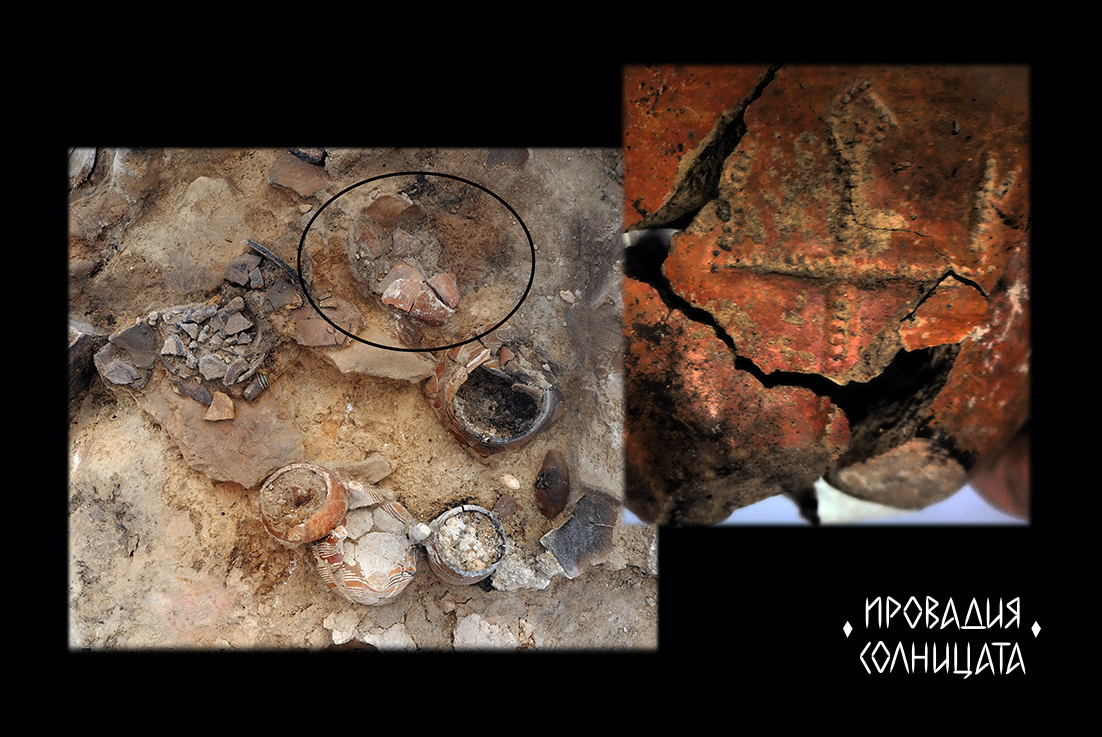
Depiction of the Mother-Goddess on a ceramic vessel
The double story construction, which had been destroyed in an earthquake, and has been under investigation the past few seasons, has again surprised the public with its architectural design and inventory. The structure has been erected and used in the Middle Chalcolithic period between 4700 - 4600 B.C. It is attached to the wall of the earliest stone defense system of the settlement. A large amount of broken on the spot ceramic vessels has been discovered amidst the debris of the western room, only to add to the vast ceramic inventory of the house. Attention has been drawn to an anthropomorphic image incised on the outer side of one ceramic pot. This is a stylized image of a person standing up with their arms, bent in the elbows and lifted high – the so-called pose of adoration. There are two upright fingers shown on each hand, while the rest are folded. Most likely this is a depiction of the Mother-Goddess calling out to the Sky God to engage in matrimonial union, or in other words - a plea for rain in the sky.
The Mother-Goddess takes a central place in the mythological-believe system of the ancient farmers and represents the cyclic pattern of rebirth of nature.